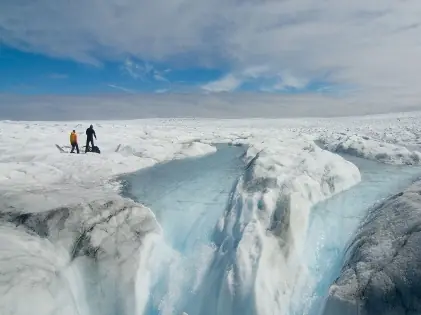
We all know about Greenland’s ice sheet melting at a break-neck speed. Greenland lost more in the last year than any given year and it has only accelerated since the 1990s. It is said that millions of US homes are now at risk of getting flooded as per new sources. What is the reason for this rapid disintegration? Well, science is not clear on that. A new study published in Nature doles out some bad news, and it is saying that the rate at which Greenland is experiencing ice melting, a phenomenon like that has not been seen in the last 12,000 years, is alarming! Over the last twenty years or so, the ice sheet has been melting at a rate of 6,100 billion tons per century, something that was seen a good 7,000-10,000 years ago!
The impact of human activity!
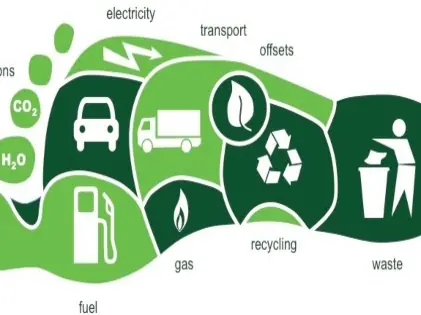
Greenland’s ice melting has been unprecedented, and the facts are scary! More so, because this has not been seen in the last 12,000 years. So, what has changed in the last few years? Obviously, human activity like greenhouse gas emissions. The ice top melting that occurred thousands of years ago was primarily because of climate variability so it was nature-made instead of man-made.
We can stall or reduce the speed at which the ice is melting
While the world at large seems concerned about the rising sea levels, are we doing enough to stop the phenomenon? Not really! We, as humans, continue to raise temperatures by increasing the heat-trapping gases. This will bring Greenland’s ice-loss levels to another level and the numbers are mind-numbing, as much as 35,900 billion tons of ice can be lost as we veer towards the end of this century.
The Current Scenario
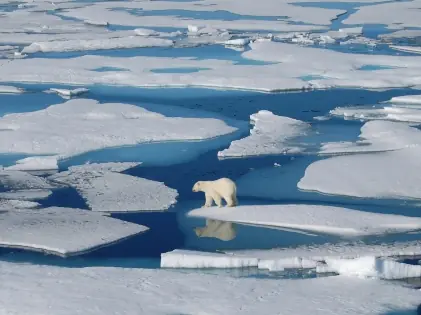
The current scenario means that the melting of the Greenland ice sheet has the potency to raise the sea level as high as 24 feet. But there’s a way out if the world gets their act together and cuts down on emissions — the ice losses then can be significantly cut down. Even if we manage to cut it down to 8,000 billion tons, we can control the sea level rise and limit it to 8,800 billion tons. It is not a great slash but here’s the takeaway: instead of raising the sea level to four inches, we can cut it down to an inch which is easily a better bargain. So, you see, we still have the control, but it depends on us and how should we use the control. What we do today will determine how the future will look like for the generations to come. And the fact that Greenland is second to Antarctica in terms of the importance of ice sheets rings the alarm bells.
The nitty-gritty of the rise of sea level
Greenland’s ice sheet has the potential to raise global sea levels by 24 feet. In the last 26 years, Greenland has raised sea levels by 0.4 inches, and it is providing stiff competition to the world’s biggest contributor to sea-level rise, Antarctica. This continent is responsible for raising the global sea level to 20-25 percent of sea level. It has the potential to raise the sea level to more than 200 feet and this is something that is clearly bothering the scientists.
The risk of the rising seas flooding the coastal areas
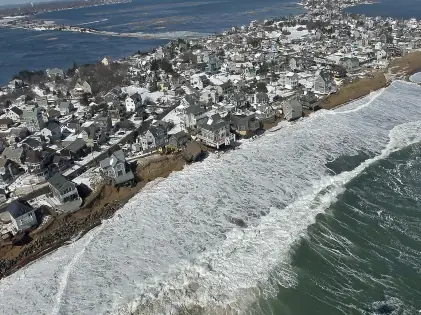
Rising seas are causing a great impact on the coastal areas. And it spells bad news for places like New York and Shanghai — yes, just a more sea-level rise of say 3 feet can mean a recipe for disaster. It can also have a negative impact on the world economy and cause damage to assets as much as $14.2 trillion by the end of the century and as many as 287 million can suffer largely because of episodic flooding. The ice-melting affected people about 12,000 years ago too, but the population wasn’t as much then as it is now. Furthermore, people neither had parking garages nor integrated modern water systems as today.
These findings prove that how we act now can clearly affect what happens a few or more years down the line. We have to give our energy systems the thought that it truly deserves. The only way to do this is to reduce our carbon footprint, protect wetlands, plant more trees, save trees, and reduce energy use. Well, while we continue to think it is not up to us, it is actually what each one of us does and how each one of us contributes!